Theory
Interfaces and Singularity: one building, any interface
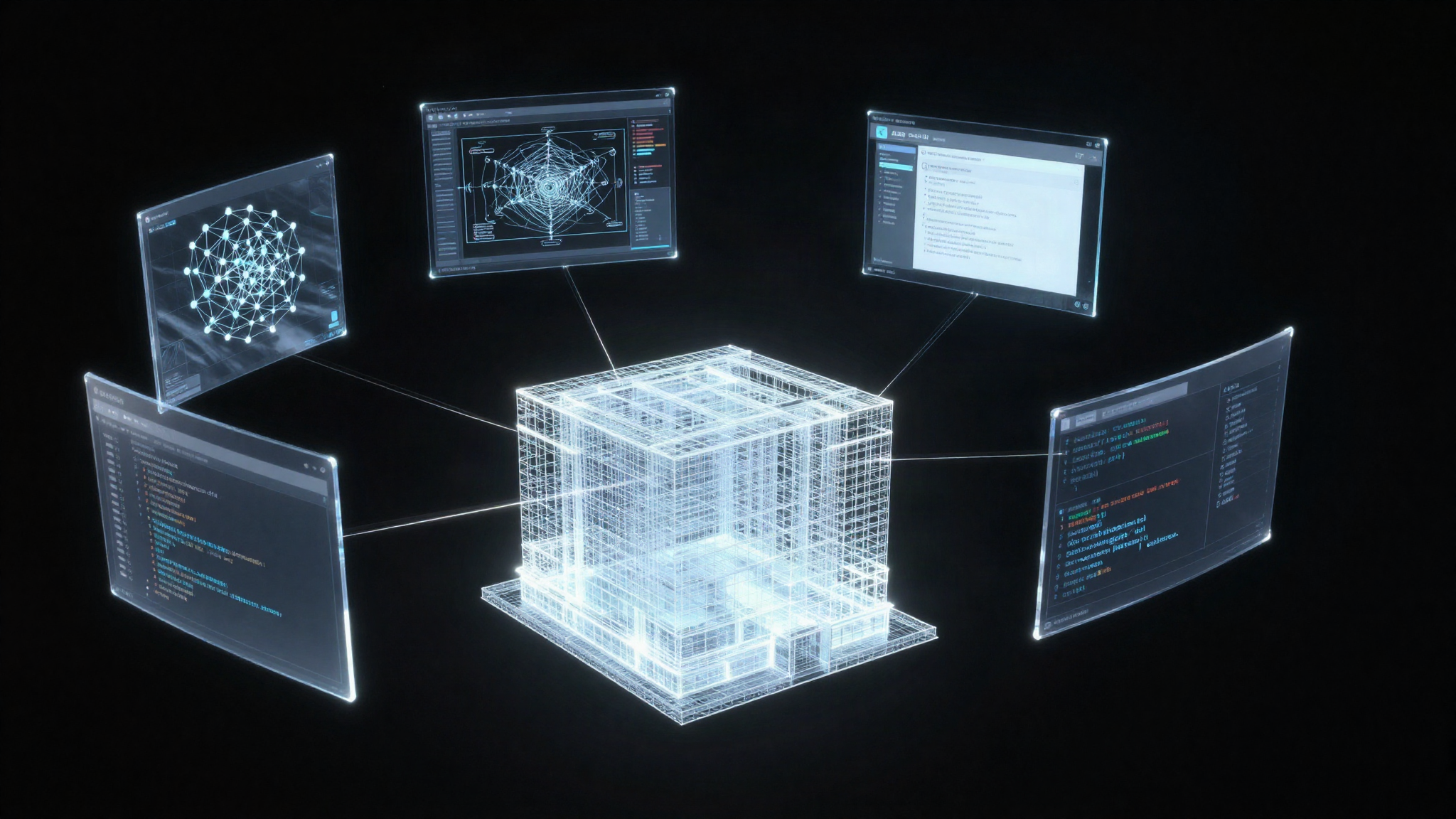
A theory by George Billam: a building should exist once, as a single open source written in code. Revit, SketchUp, Rhino, Grasshopper, a chat window and an AI agent all read and write the same source, and none of them owns it.
Interfaces and Singularity is a theory by George Billam (first set out 30/10/2026). A building should exist once, as a single open source written in code: the singularity. Every piece of software becomes just an interface on it. Revit, SketchUp, Rhino, Grasshopper, a chat window, a site tablet and an AI agent all read and write the same source, and none of them owns it.
One source holds the building. Anything can write to it, anything can ask it questions. The software is the interface, not the owner.
The web shows how this works. A website is HTML; Chrome and Safari show it differently, and no website belongs to Chrome. Buildings have never had that split, because the authoring software and the data have always been sold as one thing.
It pairs with the companion theory, Ask-Built: Ask-Built is the way out (a drawing is a query on the model), Interfaces and Singularity is the way in (modelling is editing one shared source).
The building block
Generative building design will not come from driving Revit through MCP. That route makes an AI operate software built for a human with a mouse: it clicks through dialogs, waits on regeneration, and stalls when a warning pops up. The AI is boxed into the platform's way of thinking.
The singularity is made of a more sympathetic building block: a component written as code. A wall, a door, a stair core or a whole shop unit is a small, readable definition holding three things: geometry, or the rules that produce it; data (product, fire rating, acoustic rating, cost, supplier, maintenance); and intent and constraints (why it is the way it is, so a change that breaks the reason is caught).
Because it is text, an agent can iterate it the way it iterates software: propose a change, run the checks, keep what passes, try again. Hundreds of options can be generated, tested against the brief, Approved Documents B and M and the landlord's rules, and ranked before a human looks at one. Only then does it need an interface, and it can be shown in Revit, or any other interface, as a native-looking object.
Agents inside the model
Once the building is a single open source rather than a locked file, agents can live inside it rather than poking at it from outside. They run continuously, floor by floor, element by element, the way a site manager walks a job, except every walk is complete and takes seconds.
A fire agent checks compartment lines, travel distances, door ratings and penetrations. An access agent checks clear widths, turning circles, level thresholds and Part M routes. A coordination agent finds clashes and proposes fixes rather than just flagging them. A cost agent tracks live quantities against budget as the design moves. A compliance agent logs every change against the brief, landlord rules and Approved Documents for the golden thread.
The agents don't wait to be asked. A change made by anyone, in any interface, triggers the relevant agents, and the result is waiting for review: accepted, rejected, or sent back with a reason. The designer's job shifts from producing and checking to deciding.
The interface is a skin
AutoCAD users used to switch between the ribbon and the classic menus. Same drawing, same commands, different face. Interfaces and Singularity says the whole modelling application becomes that kind of choice.
AI is making software cheap to rebuild. An interface that looks and behaves like Revit, SketchUp, Rhino or Grasshopper can be produced over an open building source, so each person works in the face they think best in: the technologist detailing in a Revit-style interface; the designer massing in SketchUp or Rhino; the computational designer in a Grasshopper-style graph; the client or subcontractor in plain conversation or a tick-box form; the agents in the raw code.
All of them edit the same building at the same time. Training stops being "learn Revit" and becomes "learn the building". A practice no longer has to pick a platform and live with it; a new starter brings whichever interface they already know.
What would have to be true
One geometry engine everyone trusts. If five interfaces edit the same wall, they must agree where the opening cuts it. Either the source stores the resolved geometry, or there is one open engine every interface calls. This is the main reason vendors keep ownership today.
Intent travels, not just shape. IFC carries the finished geometry; a door exported from Revit cannot flex like a Revit door. The building block has to carry its rules.
Every edit is signed. Anyone or anything can write, so every change needs an author, a time, a reason and a check. Git for buildings. This is also what the golden thread asks for.
Someone forces it open. Vendors earn from owning the format. Openness most likely arrives through regulation, a large client or government mandate, or open-source tools becoming good enough to win anyway.
Interfaces are built, not copied. "Feels like Revit" is fine; copying Revit's code or look wholesale runs into licence terms and intellectual property.
What already exists
IFC5 (buildingSMART) is a JSON-based rework of IFC aiming at shared ownership through layers and incremental updates, but it is still alpha and built for exchange rather than as the live source you design in. Speckle offers open, versioned object data with connectors into Revit, Rhino, AutoCAD and others, but authoring stays in each app and data is translated in and out. Autodesk's AEC Data Model breaks Revit and DWG files into cloud-queryable object data, but it is open on Autodesk's terms, in Autodesk's cloud. None of these makes the open source the master building with every application as an interface on it.
Soundbites
"The building is the source code. Revit is just one interface."
"We're going to switch between Revit and Rhino the way we used to switch between the ribbon and classic menus."
"Generative design won't come from an AI driving Revit. It'll come from a building block an AI can rewrite."
"Stop learning software. Learn the building."
"Agents don't check the model at the end. They live in it."